
Toll receipts that survive an expense check
A toll receipt is not really a record of a purchase. It is a record of a decision somebody made about your vehicle at a barrier, and the amount only makes sense once that decision is printed alongside it.
The amount on a toll slip is an output, not an input. Vehicle class and journey type produce it.
A receipt showing only a total cannot be verified by anyone. Class and crossing point are what make it checkable.
Electronic tolling usually hands over nothing at the barrier. The record arrives later, as a statement.
For a public road, the authoritative copy comes from the operator or your tag account. Ask them first.
Expense reviewers want one line per crossing, with date, time and direction. A monthly total rarely clears.
Choose a template to get started
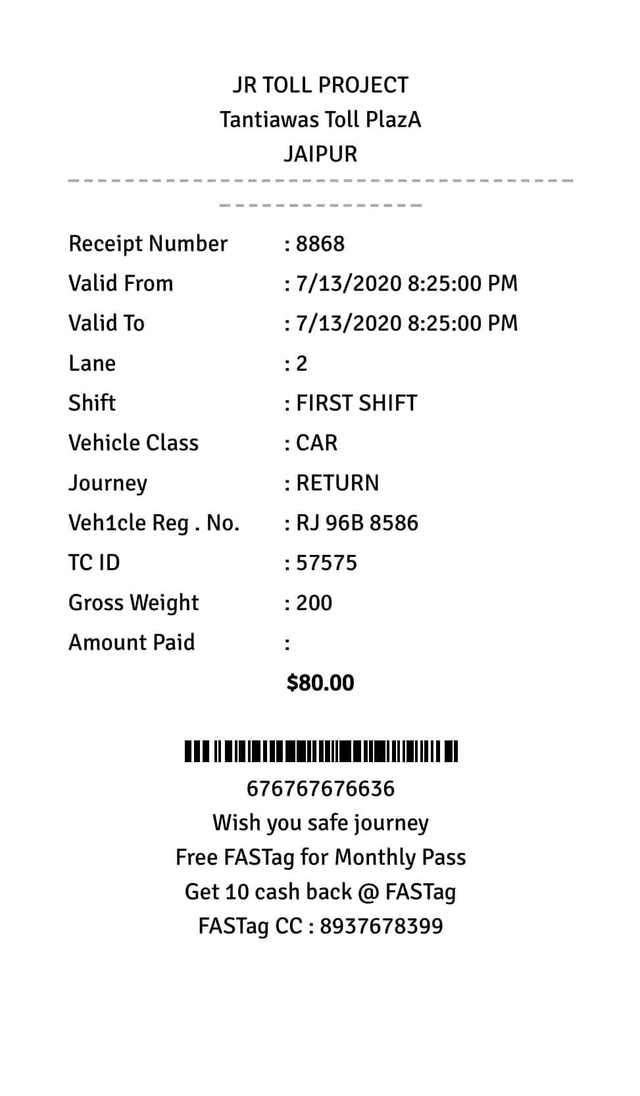
A toll receipt looks like the simplest document on this site. One amount, one place, one moment. In practice it carries more judgement than a shopping receipt does, because the figure printed on it was produced by classifying your vehicle and your journey against a schedule, in a second or two, at a barrier. Reproduce the amount without reproducing the classification and you have a slip that proves a payment happened but not that it was the right one. That gap is why toll lines get queried in expense reviews more often than their size suggests.
What a toll receipt actually records
A retail receipt lists things you chose. A toll receipt lists a crossing you were charged for, and the charge was set by somebody else applying a published schedule to your vehicle.
So the document has three jobs rather than one. It evidences that money changed hands. It identifies which crossing, in which direction, at which moment. And it shows the classification that produced the amount, which is the part people leave off.
That third job is the one that matters when a receipt is read later. An expense reviewer, an auditor or a client being rebilled is not checking whether you paid. They are checking whether the amount belongs to the journey being claimed. Without the crossing point and the vehicle class on the slip, there is no way to tell.
Nobody disputes that you paid. They dispute that this amount belongs to this journey.
Who issues a toll receipt, and who does not
Worth being direct about this, because it decides what this page is useful for.
For a public road, bridge or tunnel, the receipt belongs to the operator. Only the road authority or its concessionaire can issue an authoritative record of a crossing on its network, and if you need one for a journey you have already made, that is who to ask. Most run an account portal, an email request route, or a plate-based lookup. Start there, not here.
Private access charges are a different matter, and they are far more common than people assume. Estate and private roads, logistics yards and distribution centres, port and terminal gates, private bridges and ferry slipways, industrial sites, quarries, and barrier-controlled car parks all levy access or crossing charges, and all of them have to issue their own documentation. Nobody prints it for them.
The third case is a slip you were given and no longer have in readable form. Thermal print fades, and a crossing receipt lives in a door pocket in direct sunlight, which is roughly the worst possible storage. Rebuilding a record from the detail you hold, while asking the operator for the authoritative copy, is an ordinary bookkeeping task.
The two fields that decide the amount
Almost every charging schedule in the world turns on the same two variables, however differently they are labelled.
Vehicle class. Operators separate traffic by some combination of axle count, height, gross weight, and whether a trailer is attached. A two-axle car, a light commercial van, a rigid truck and an articulated unit sit in different bands, and the gap between bands is usually large enough that misclassification is obvious when someone checks.
Journey type. A single crossing, a return within a validity window, a day pass covering multiple crossings, a season or monthly pass, and local or exempt categories are all priced differently. A return charged as two singles is one of the more common quiet overcharges on a long trip.
Print both. A slip showing the class and the journey type lets anyone reconcile the amount against the published schedule without calling anybody. A slip showing neither asks the reader to take the figure on trust.
Country-specific class tables get detailed quickly. The national highway slip format, with its own class numbering and tag fields, is covered on the JR toll receipt page rather than here.
What a crossing slip has to carry for somebody who was not there to reconcile it.
| Field | Why it matters | Status |
|---|---|---|
| Operator or facility name | Who levied the charge. Print the name a reader will recognise, which is not always the legal entity on the bank statement. | Required |
| Barrier or plaza name | Which crossing point. Without it the amount cannot be checked against any schedule. | Required |
| Lane or booth | Narrows a query to one stream of traffic instead of a whole site. | Recommended |
| Date and time | The moment of the crossing. Time matters where charges vary by period or where a return window applies. | Required |
| Direction | Inbound or outbound. The field that separates a leg from its return on the same day, and the one most often omitted. | Required |
| Vehicle registration | Ties the crossing to a vehicle. Essential for fleet reconciliation and for rebilling a client. | Where captured |
| Vehicle class | The band applied: axles, height, weight or trailer. Half of what produced the amount. | Required |
| Journey type | Single, return, day pass, season or exempt. The other half, and the one that explains an unexpected figure. | Required |
| Tag or transponder reference | Last digits only where a tag was read. A full account identifier does not belong on a copy left in a vehicle. | Partial only |
| Charge and payment method | The amount and how it was settled, for matching against a statement or an account balance. | Required |
| Tax line | Only where the crossing charge genuinely attracts tax. Many do not, and an invented tax line creates a problem rather than solving one. | Where it applies |
| Balance after | Remaining value where the payment came from a prepaid account, so the driver can see it without logging in. | Prepaid only |
| Receipt or transaction number | Unique to that crossing. What turns a later query into a lookup instead of a search. | Required |
Create a toll receipt in four steps
Pick a crossing layout
Start from a toll or access template rather than a retail one, so the class and direction fields are already there.
Enter the crossing
Operator, barrier, lane, date, time and direction. Your facility details carry over between receipts.
Set class and journey type
The band applied and whether it was a single, return or pass. These are what justify the amount.
Download or send
Export as PDF or PNG, or email it. Check it is legible at full size before it goes to a driver.
Tracing a crossing when nothing was handed over
Electronic and open-road tolling has made the receipt-at-the-barrier the exception rather than the rule. You drive through, a camera or a tag reader does the work, and the record surfaces later.
Your tag or transponder account statement is the first place to look. These carry a line per crossing with date, time, plaza and amount, which is exactly the granularity an expense reviewer wants, and most can be exported for a chosen date range.
If there was no tag, a plate-based lookup on the operator’s site often retrieves the crossing, and a pay-by-plate invoice usually arrives by post or email within a few weeks. Hire cars are their own case: the toll typically appears on a separate administration invoice from the rental company rather than on the rental agreement, so it is worth asking for before you file the trip.
Expense policies tend to want one line per crossing rather than a monthly aggregate, and tolls are commonly treated as separately claimable on top of a per-mile or per-kilometre allowance rather than being swallowed by it. Policies differ, so check yours, but the practical effect is that keeping crossings itemised is usually worth money.
Capture the statement the week you travel. Portals routinely cap history at a few months, and the crossing you need is always the one that has just rolled off the end of the window.