
Generate Pharmacy Receipts: Choose your Preferred Style
A pharmacy receipt has a second job most receipts never have: somebody who was not there has to read it and decide whether the purchase qualifies. Five pieces of information decide that, and a till slip often carries only three.
Five pieces of information decide a claim: patient, provider, date, a specific description, and the amount.
A card slip is never enough, because it shows what was charged but not what was bought.
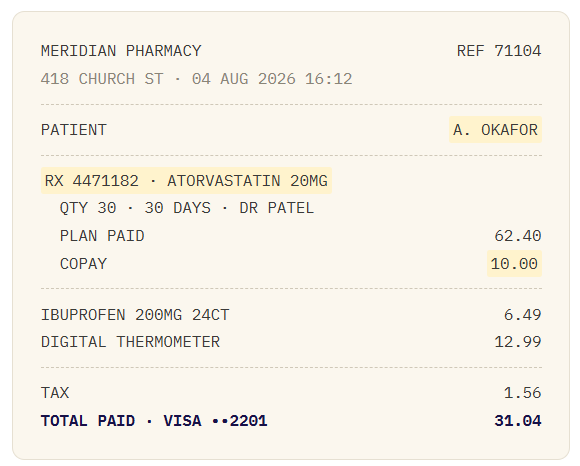
Prescription lines need the fill date, not the pickup or payment date. Administrators check this.
Claim the copay, not the sticker price. The claimable figure is what you paid after insurance.
Legibility is a rejection reason in its own right. A faded or cropped receipt gets sent back.
Choose a template to get started
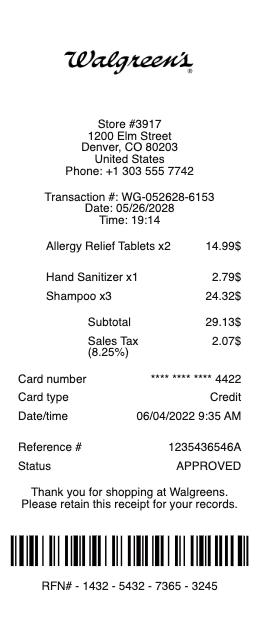
Most receipts are read once and thrown away. A pharmacy receipt gets filed, submitted months later, and assessed by an administrator deciding whether to release money against a tax-advantaged account. That person was not in the shop, cannot see the item, and will not call to ask. Everything they need has to be printed on the slip, which is why pharmacy receipts carry fields no other retail receipt bothers with.
A pharmacy receipt does two jobs
The first is ordinary. It proves a customer paid, supports a return, and feeds the shop’s own records.
The second is what makes the format different. It is the document that unlocks reimbursement from a health spending account, and increasingly it is the only thing standing between a patient and their own money.
That second reader is the one to design for. They are assessing eligibility rather than confirming payment, and they cannot approve what the receipt does not show. A pharmacy that prints a vague slip is not just being unhelpful, it is creating work for its customers that lands back at the counter as a request for a reprint.
The five elements an FSA or HSA claim needs
Claim administrators look for the same five things. Miss one and the claim is queried or denied.
- Patient name. The person who received the item or care. Not necessarily the employee, since a spouse or dependent qualifies.
- Provider name. The pharmacy, store, or practice.
- Date. When the item was purchased or the service given.
- Description of the item or service. Named specifically. "Prescription medication" or the drug name, not "merchandise".
- Amount paid, separated from tax and from any non-qualifying items in the same basket.
Two things that are not sufficient on their own. A credit card slip or bank statement, because neither itemizes. And your own word: self-substantiation is not permitted under the cafeteria plan rules governing FSAs.
What prescription lines need
Over-the-counter lines follow the five elements above. Prescriptions need more. Claim the copay, not the sticker price. For HSA reimbursement, the claimable amount is what you actually paid after insurance. Claiming the full price of a drug your plan mostly covered is how a reimbursement gets clawed back. Where a basket mixes eligible and non-eligible items, separate them clearly. An itemized receipt layout is what makes that possible.
Components of a pharmacy receipt
The Business
- Name, address, phone
- Logo
- Tax registration number
The Transaction
- Date and time
- Receipt or reference number
- Currency
- Customer or patient name
- Payment method
The Items
- Item number and name
- Unit of measurement
- Quantity and unit price
- Discounts applied
- Tax and total
Pharmacy-specific
- Rx number and drug name
- Days supply, prescriber
- Copay / plan-paid split
- Return policy
- Confidentiality note
A confidentiality note matters because customers' personal health information is protected under health privacy rules.
Reissuing a lost pharmacy receipt
Patients lose receipts and then need them at claim time. Handling that properly is straightforward.
If you run the pharmacy: reissue from your transaction records. Most systems can reprint against a rewards card or a prescription number, and a patient can also request a prescription purchase summary covering the last twelve months.
If you are the patient: ask the pharmacy to reprint, or pull the purchase from the chain's app. Do not reconstruct a receipt for a purchase you cannot evidence.
Once you have it, keep the receipts. FSA and HSA records should be held for at least three years, because the IRS can ask you to substantiate any distribution. A pharmacy slip filed as an expense receipt is exactly what gets requested. The Receiptmakerly online receipt generator stores every receipt you create for later access.
Which businesses use this format
- Pharmacies and drugstores, the primary case.
- Convenience stores selling health and personal care items.
- Grocery stores with a pharmacy counter, alongside standard grocery store receipts.
- Retail stores selling FSA-eligible items such as first aid, vision, and mobility products.
Receiptmakerly also covers Lyft receipts, creating taxi receipts, and generating amazon style receipt formats.
CREATE A PHARMACY RECEIPT IN FOUR STEPS
Pick a pharmacy layout
Start from a dispensing or drugstore template rather than a general retail one, so the prescription fields are there.
Enter patient and dispensing detail
Patient name, fill date, prescription number, drug and quantity. Your pharmacy details carry over between receipts.
Split the money
Copay on one line, plan-paid on another, tax separately where it applies. Name every retail item specifically.
Download or send
Export as PDF or PNG, or email it. Check it is legible at full size before it goes out.
Disclaimer: Receiptmakerly.com is a web-based application that helps businesses and individuals create professional-looking receipts and bills. Our software generates each document from the information you enter, and you are solely responsible for the accuracy of that information and for how the finished document is used. We do not review or verify the content of receipts created by users, and our Terms of Use prohibit creating any receipt that misrepresents a transaction. All product and company names are trademarks or registered trademarks of their respective holders. Use of them does not imply any affiliation with or endorsement by them. Where a receipt supports an FSA, HSA or insurance claim, a receipt that misstates what was purchased is a false claim against that plan.