
Fuel and gas receipts: the quantity matters more than the amount
Most receipts get checked against a price. A gas station or forecourt slip gets checked against a tank, an odometer and a per-unit rate, which means the volume printed on it is doing far more work than the total.
Quantity, unit price and total have to reconcile. That arithmetic is what makes a fuel receipt checkable.
Always print the unit. Litres, gallons, kilograms and kWh are not interchangeable and the slip has to say which.
Grade and pump number are not decorative. They tie a transaction to a vehicle and to the gas station’s own record.
Fuel and a mileage allowance are usually an either/or. Claiming both is the commonest fuel expense error.
Odometer is the field a fuel card statement cannot give you. Capture it at the pump or it is gone.
Choose a template to get started
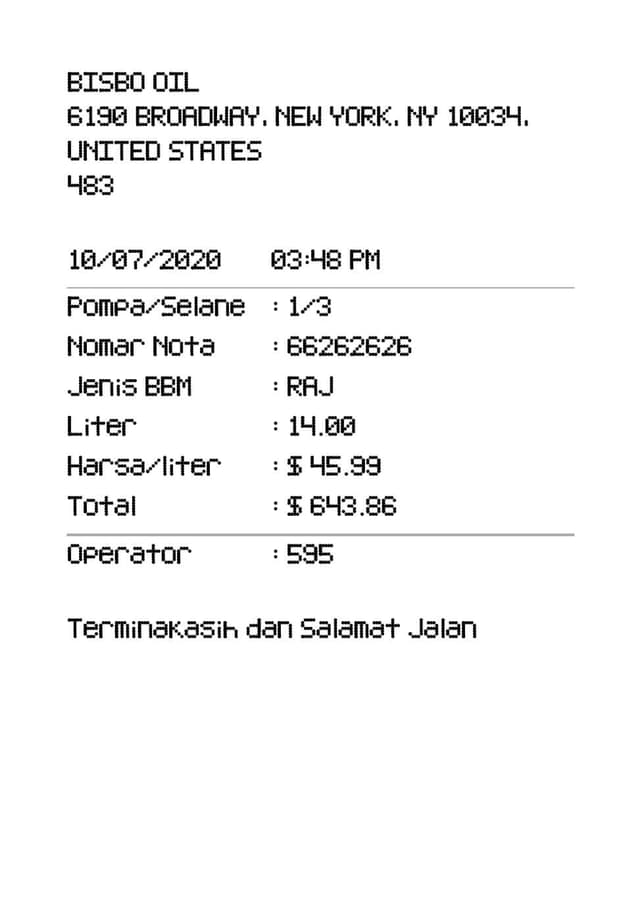
A fuel receipt is the only everyday receipt that carries its own proof. Quantity times unit price equals total, printed on the same slip, so anyone reading it can check the arithmetic without leaving the page. No grocery receipt does that. No restaurant bill does that. And because the volume is there, a second kind of checking becomes possible: against the size of the tank, against the distance travelled, against the grade the vehicle actually takes. That is why fuel receipts get scrutinised more closely than their value suggests, and why a slip showing only a total is close to useless to the people who have to read it.
Why the volume is the control
Strip a fuel receipt back and there are three numbers: how much fuel, what it cost per unit, and what was paid. Any two of them produce the third, which makes the slip self-checking in a way almost no other receipt is.
That is the first reason volume matters. The second is that it connects the receipt to the physical world. A tank has a capacity, so a claimed volume larger than the tank is visibly wrong. A journey has a distance, so volume against odometer produces a consumption figure, and a consumption figure that is implausible for the vehicle is a question somebody will ask.
None of that works from a total alone. A receipt reading nothing but an amount tells a reviewer that money was spent at a forecourt, which they were not doubting. It cannot tell them whether the fuel went into the vehicle being claimed for, and that is usually the actual question.
So the rule for anyone issuing or reconstructing a fuel receipt is simple. Print the quantity, print the unit, print the price per unit, and let the total be the number that follows from them rather than the only number on the page.
Every fuel receipt — gas, petrol, diesel and the rest
The whole family sits in this category, and each type changes at least one field. That is worth knowing before you pick a template.
- Petrol and gasoline. The baseline. Grade is the field that earns its place, because grades price differently and a premium grade on a vehicle that takes regular is a thing fleet managers look for. Volume in litres or gallons depending on where you are.
- Diesel. Same shape, different grade naming, and one extra reason to print it: a misfuelling event is expensive, and a receipt showing the grade is the document that establishes what actually went in. Commercial diesel is also where fuel cards dominate, so the transaction often carries a driver and vehicle reference as well.
- LPG, autogas and CNG. Here the unit itself changes. LPG is normally sold by the litre, compressed natural gas by the kilogram, and a slip that prints a bare quantity with no unit is ambiguous in a way a petrol receipt never is. Print the unit explicitly.
- DEF and AdBlue. Not fuel, bought at the same forecourt, and frequently on the same receipt as a diesel fill. It belongs on its own product line with its own quantity, because it is consumed at a different rate and reconciles against nothing that diesel reconciles against.
- EV charging. The newest member and the one that breaks the template. Energy in kWh rather than volume, a session with a start and an end rather than a moment, a charger and connector reference instead of a pump number, and often two charges on one receipt: a rate per kWh plus a time-based or idle fee. A charging receipt that shows only money is missing most of what makes it useful.
- Off-road, agricultural and marine fuel. Priced differently from road fuel in many places, and the receipt commonly has to record the intended use or carry a declaration to that effect. What is required varies by country and by trade, so confirm your own obligations rather than copying a road-fuel layout.
- Bulk delivery into a tank. No pump and no forecourt. The slip carries a delivered volume, a site or tank reference, and in some trades a temperature-corrected figure alongside the metered one. It reconciles against tank dip readings rather than against an odometer.
Anatomy of a gas station or forecourt slip
Fuel receipts are narrow and operators abbreviate aggressively, so it is worth knowing which fields are load-bearing.
The transaction block is the site name and address, the date and time, the pump or nozzle number, and a transaction reference. Pump number is the one people assume is noise. It is not: it is what ties a disputed transaction to one dispenser and to the site’s own records, which turns a query into a lookup.
The product block is the grade, named rather than coded where you have the room, the quantity, the unit, and the price per unit. Three of those four are frequently dropped on handwritten or reconstructed slips, and dropping any of them removes the arithmetic that makes the receipt verifiable.
The vehicle block is where fuel receipts differ from almost everything else. Registration or fleet vehicle number, and the odometer reading. Odometer deserves singling out, because it is the one field a fuel card statement will never contain unless it was entered at the pump. Miss it there and the consumption figure for that fill is gone permanently.
Then the money: total, tax on its own line where it applies, payment method with the last digits of the card, and loyalty or discount lines kept separate from the fuel price so the gross and net are both visible.
| Field | Why it matters | Status |
|---|---|---|
| Site name and address | Which forecourt or depot. Print the name a reader will recognise, which is not always the entity on the card statement. | Required |
| Date and time | The moment of the fill. Time matters for matching against a card statement line and against a journey. | Required |
| Pump or nozzle number | Ties a disputed transaction to one dispenser and to the site’s own records. Turns a query into a lookup. | Required |
| Product and grade | Named rather than coded where there is room. Grades price differently, and grade is what establishes what actually went in. | Required |
| Quantity | How much fuel or energy. Half of the arithmetic that makes the receipt self-checking. | Required |
| Unit | Litres, gallons, kilograms or kWh, stated explicitly. A bare quantity is ambiguous for anything but petrol and diesel. | Required |
| Price per unit | The rate charged. With quantity and total, it lets anyone verify the figure without asking you. | Required |
| Vehicle registration or fleet number | Which vehicle the fuel went into. The field that connects the spend to an asset rather than to a person. | Fleet |
| Odometer reading | Distance at the fill. The one field a card statement cannot supply later, so capture it at the pump or lose it. | Fleet |
| Driver reference | Who filled up, where a fleet tracks by driver as well as vehicle. | Fleet |
| Session start and end | For charging rather than fuelling, where duration affects the charge and an idle fee may apply. | EV only |
| Charger and connector reference | The charging equivalent of a pump number, identifying which unit delivered the energy. | EV only |
| Tax | Its own line where it applies to your sale. Fuel taxation differs by country and by use, so confirm your position with your accountant. | Where it applies |
| Total and payment method | The amount charged and how it was settled, with card last digits for matching to a statement. | Required |
| Loyalty or discount lines | Kept separate from the fuel price so the gross and the net are both readable. | Optional |
| Transaction number | Unique to the fill. What makes a later query answerable in seconds. | Required |
Fuel, mileage, and the mistake almost everyone makes
This is the part of fuel expenses that costs people real money, so it is worth stating plainly.
A per-mile or per-kilometre allowance is generally designed to cover fuel already, along with wear, servicing and depreciation. So claiming the allowance and the fuel receipts for the same journey is usually claiming the same cost twice, and it is the single most common error in travel expense claims.
The contrast with other travel costs is what confuses people. Toll receipts and parking receipts are commonly treated as separately claimable on top of a mileage allowance, because an allowance per distance does not contemplate a barrier or a car park. Fuel is different, because fuel is exactly what the per-distance rate is pricing.
Which route is better depends on the vehicle, the annual distance and the rules where you are, and the answer genuinely differs between a small efficient car and a large van. Rates and eligibility also change, so treat this as the shape of the decision rather than the decision itself, and confirm your own position with your finance team or your accountant.
Whichever you use, keep the receipts. Even on a mileage claim they establish that the journeys happened and that the vehicle was in use, and a reviewer querying a distance will ask for them.
Fuel is rarely the only line in a travel claim either. Where a journey was taken rather than driven you may also need to create receipts for Taxi services, and the fare formats work on the same principle of showing the components rather than the total, with OLA Style Taxi Receipts and Uber Style Taxi Receipts covering the two most commonly claimed.
Create a fuel or gas receipt in four steps
Pick the fuel type
Start from the layout that matches what was sold. Petrol, diesel, LPG, charging and bulk delivery all need different fields.
Enter the transaction
Site, date, time and pump number. Your site details carry over between receipts, so you enter them once.
Set quantity, unit and rate
Grade, quantity with its unit, and the price per unit. Let the total follow from the arithmetic rather than typing it alone.
Add the vehicle, then export
Registration and odometer where you track them. Export as PDF or PNG, or email it straight to the driver.
Fuel cards, reconciliation, and getting a copy
For anyone running more than a couple of vehicles, fuel stops arrive as two parallel records that have to be matched, and understanding why both exist saves a lot of time.
The fuel card statement is the authoritative money record. It carries the merchant, the date, the product, the quantity, the unit price and the total for every transaction on the account, and it arrives in a form you can export and reconcile in bulk.
The receipt carries what the statement cannot: the odometer, if it was captured, and the physical confirmation that a specific driver was at a specific pump. Fleet programmes that prompt for an odometer entry at the pump are solving exactly this gap, and the ones that do not are relying on the paper slip to carry it.
A workable reconciliation matches three things per fill: the card line, the receipt, and the vehicle. Breaks in that chain are where fuel loss hides, and the usual break is a receipt that never made it back because it lived in a cab until it faded.
On copies: gas stations and forecourts can normally reprint a transaction the same day and often for some days afterwards, and a fuel card portal or loyalty account will usually hold the history for longer. As with any thermal slip, photographing it at the pump is a better habit than hoping it survives the glovebox, and rebuilding a record from the detail you hold is an ordinary bookkeeping task when the original has faded.
Fuel is one format among many in the same builder, which also covers Amazon’s order layout, Walmart grocery slips and Walgreens pharmacy receipts. The home page lists the full set, and access runs on a monthly or annual subscription.